
Myrtle Beach had a historically dry month. Here’s how dry and if this week’s rain end the drought
After a record dry October, the South Carolina Department of Natural Resources’ (DNR) Drought Response Committee declared all 46 South Carolina counties are officially in an incipient drought.
“It is, climatologically, our driest time,” said South Carolina Department of Natural Resources (DNR) state climatologist Hope Mizzell. “October, November are our driest months, even with normal rainfall.”
Precipitation in South Carolina averages 2.99 inches in October and 2.61 inches in November, according to precipitation data going back to 1895. But this year’s been exceptionally dry.
Last month, precipitation across the Palmetto State averaged just 0.13 inches. It was the second-driest October on record and the driest October since 2000, when South Carolina got just 0.02 inches of rain.
With a monthly total of 0.19 inches of rain, Horry County had slightly more precipitation than the state average, but was still 2.85 inches short of its October average.
Since the Drought Response Committee announced the drought declaration last week, much of South Carolina has seen rain. The committee won’t meet again until Dec. 4 to officially decide which counties are still in a drought and if some conditions have improved.
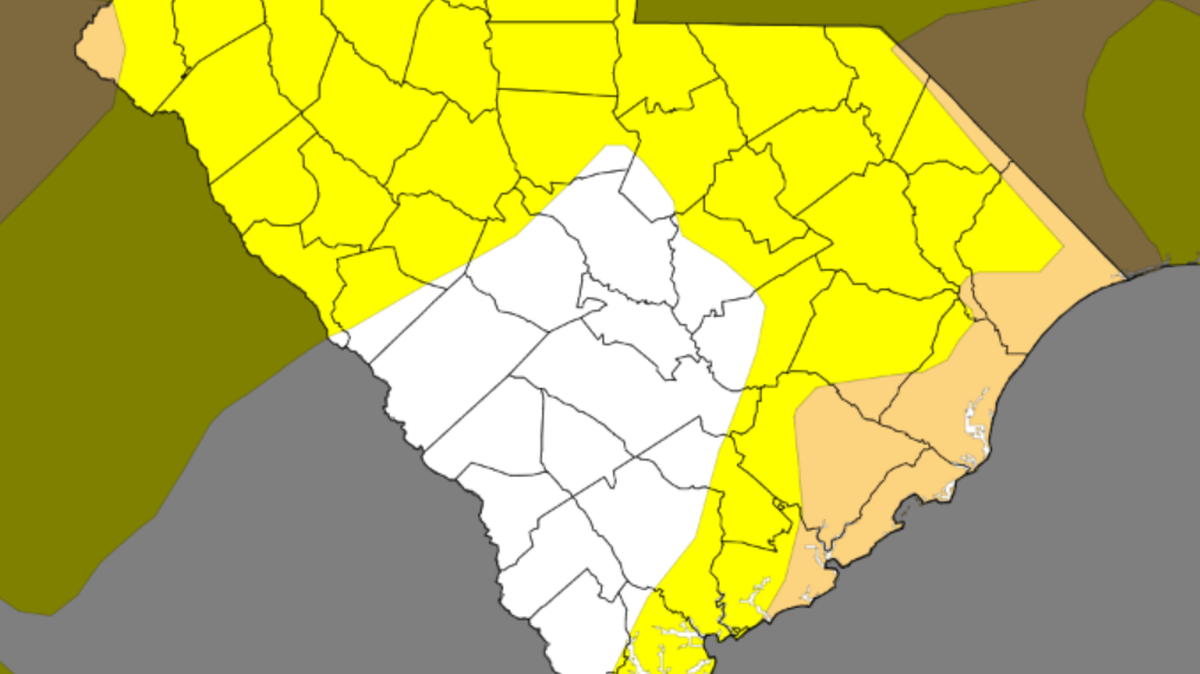
According to the U.S. Drought Monitor, on Nov. 5 about 36% of South Carolina was impacted by moderate drought conditions and the remaining 64% was abnormally dry. On Nov. 12, only about 11% of the state was in moderate drought conditions, 72% was abnormally dry and 28% wasn’t experiencing any dryness.
Coastal drought
Despite this precipitation, drought conditions have persisted in much of South Carolina’s coastal communities and actually worsened in Horry County since the committee’s meeting.
“For Horry County, the rainfall really tapered down to at most a half an inch, maybe a little over a half an inch,” Mizzell said Wednesday. “And since that had been so dry, it was welcome rain, but that by no means was enough to end the drought in Horry County.”
According to the U.S. Drought Monitor, nearly 63% of Horry County residents were impacted by moderate drought conditions on Nov. 12 — up 10% from last week — and the remaining 37% were in abnormally dry conditions.
Getting rain
But how much rain does the county need to end the drought? That all depends on how the rain falls.
Brief, isolated rain events don’t benefit the area the same way consistent precipitation does. Even if an area gets several inches of rain, if it comes too quickly, the drought-dry ground can’t absorb as much water and generates runoff instead.
“I can’t give an exact number, it’s more so that what’s needed is a return to a more normal pattern of rainfall,” Mizzell said. “We just entered the first stages of drought again in October, so it’s not like it’s going to take months and months of above-normal rainfall … literally, a couple of months of normal rainfall this time of year should be sufficient in recovering from the drought.”
Winter forecasts
On top of that, NOAA predicts Horry County and surrounding areas will have below-normal precipitation this winter because of a potentially developing La Nina. If the low rainfall continues through the winter it could extend the drought into the spring.
“I think if you ended up having a very dry winter, then you would certainly be concerned going into spring, because in the winter is when we recharge our groundwater and our surface water,” said Mizzell.
While we don’t know how long the drought will last, Mizzell says it’s “encouraging” that, heading into winter, the water levels in South Carolina lakes are normal and most stream flows are near normal.
“It’ll just depend on how much rain we get over the winter, if it ends up extending into the spring, and there’s just no way to be able to know what the forecast looks like that far out,” Mizzell said.
Although the state commission won’t reconvene to analyze South Carolina’s precipitation patterns and officially update counties’ drought statuses until next month, the U.S. Drought Monitor updates data on its website weekly.
This story was originally published November 16, 2024 at 6:00 AM.