SC girl with rare disease needs expensive testing. Her brother might need it soon, too.
Vanessa Ruiz has a choice to make.
She can save money for her daughter, Faith, to get thousands of dollars in medical testing done, or she can put food on the table. That was difficult enough, but now she faces the likelihood of her son being diagnosed with the same disease, doubling the burden of the expensive testing.
“If you go and take your rent money and you go pay a doctor’s bill, you’re going to be homeless, you’re not going to have a place to live,” Vanessa Ruiz said. “You go buy the medicine that your doctor gave you, that’s your light bill right there. People shouldn’t have to live in fear like that.”
Bardet-Biedl Syndrome (BBS) is a rare genetic disease that affects around 3,000 people across the U.S. There is no cure.
The only specialist in the country is located in Marshfield, Wisconsin, around 1,100 miles away from the Ruiz’s home in the Myrtle Beach area.
BBS affects nearly every part of the body, sometimes leading to severe kidney issues and extreme weight gain. Most patients are legally blind by age 15.
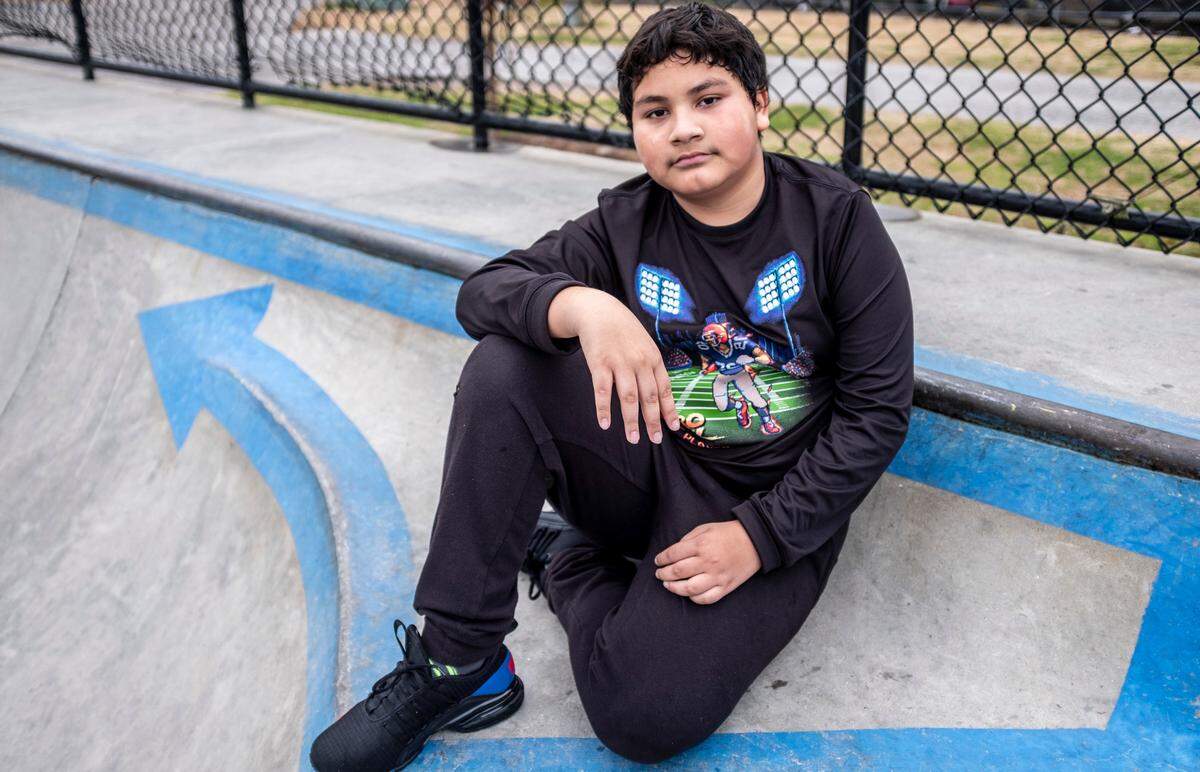
Erali Ruiz, Vanessa’s son, likes to ride on his scooter through the park and play on his phone. At 12 years old, he likes to keep the attention of his mom and entertain the family.
He’s likely to be diagnosed with BBS as well.
Erali Ruiz has genetic testing scheduled for November, and doctors have told Vanessa Ruiz they’re “95% sure” he has BBS, stopping just short of an official diagnosis. He has autism and a learning disability, and his mom says it’s difficult to explain to him what’s going on with his health.
It’s not uncommon for BBS patients to have siblings with the same disease, or for BBS patients to have “autistic like features,” according to Dr. Robert Haws, who runs the Center of Excellence for Bardet-Biedl Syndrome at the Marshfield Clinic. Around 25% of children whose parents can pass on BBS have the disease, Haws said.
Testing for BBS patients typically costs at least $15,000, according to Haws. For two children in the same family to get testing and begin treatment, it would likely cost between $30,000-$40,000.
That’s something the Ruiz family can’t afford right now. They have insurance through Medicaid, but out-of-state care often isn’t covered.
“It doesn’t matter who you are, if you’re rich or poor, if you have a child or a loved one who’s sick that requires out-of-state visits, the health care should be free,” Vanessa Ruiz said.
A GoFundMe page has raised more than $10,000 for the Ruiz family following news coverage of their situation.
“It does show that there are people out there that really care and that really want to help,” Vanessa Ruiz said.
A charity organization has offered to fly Faith Ruiz to Wisconsin for her testing, helping to decrease the overall costs by covering transportation. But that still leaves a significant gap for the family.
“The money is great, we’ll work with the family as best we can to provide the best services possible,” Haws said. “Obviously, the more funding, the more complete the examination and evaluations can be done.”
Though some care can be done at local hospitals and the Marshfield Clinic works with insurance companies and other healthcare providers to mitigate costs, the pinnacle of care for BBS can only be found at the Marshfield Clinic.
Gene therapy and a drug aiming to alleviate obesity are both glimmers of hope for people in the BBS community, Haws said. Clinical trials for gene therapy could be starting within the next two years, and a new drug for obesity could be evaluated by the Food and Drug Administration in the coming year.
Vanessa Ruiz gets disability income and food stamps, and her husband Javier had a hard time finding work earlier in the pandemic. She drives for Uber Eats when time allows, but with kids at home and car troubles, it doesn’t work out as often as she’d like.
The family is considering putting on a fundraiser event and selling snacks and meals to the community to raise money for testing, but those plans are in the early stages and Vanessa Ruiz isn’t sure they can shoulder the upfront costs. With her son’s diagnosis imminent, she says she’s trying to keep her sights set on getting to Wisconsin for testing, but some costs are more immediate.
“I’m just ready to throw in the towel and give up,” Vanessa Ruiz said. “But I don’t want to because those are my kids. It’s taken a really big toll on me.”
This story was originally published July 23, 2021 at 6:58 AM.