What Myrtle Beach is doing to address ocean water quality and how much it could cost
High bacteria levels along the Myrtle Beach shore have resulted in a proposed $22.6 million project to clean up the city’s largest watershed.
As stormwater from Withers Watershed continues to drain into the Atlantic Ocean, the city has spent the last year working to address water quality and quantity, along with preserving, improving and protecting the existing flow paths and infrastructure of the basin.
The basin includes 3,500 drainage structures, 40 linear miles of drainage pipe, and 21 miles of open streams and channels.
Currently, rainwater drains into pipes and streams and dumps into Withers Swash, near Fourth Avenue South, where stormwater runoff that includes pollutants and bacteria drains into the ocean.
However, due to the abnormal amount of enterococcus bacteria detected in the ocean, Withers Swash has remained in a long-term swimming advisory status since 2007, according to the S.C. Department of Health and Environmental Control.
This year, DHEC reported nearly 20 occurrences in which substantially high bacteria levels were detected at Withers Swash, with some of the highest levels reported over the summer, according to weekly bacteria samples provided to The Sun News from DHEC via a Freedom of Information Act Request.
Last year, the city hired engineering consulting firm WK Dickson to study drainage in the Withers Basin, an over three-square-mile basin that spans from 19th Avenue North to 17th Avenue South and inland to Seaboard Street.
On Tuesday, the firm presented its findings to residents and officials at the Myrtle Beach Train Depot, citing 16 water quality treatment projects focused on bacterial and pollutant removal, 11 major infrastructure projects to improve water quantity, along with seven minor infrastructure projects.
“All the water that falls within that three-square mile area ultimately drains into the pipes and streams down through the Withers Swash into the Atlantic Ocean,” WK Dickson project manager Tom Murray said. “As water runs off the roads and houses and lawns, it ends up carrying pollutants into the stream, so we want to look at solutions to address that.”
While each project aims to mitigate flooding and reduce bacteria levels, Public Works director Janet Curry has said the reduction won’t solve the overall problem.
Withers Swash, bacteria & swimming advisories
Withers Swash is one of 13 beach monitoring locations currently under a long-term swimming advisory, according to DHEC.
Long-term advisories are issued two ways.
When a monitoring location has an increased possibility of high bacteria levels due to stormwater from pipes or swashes flowing across the beach to the ocean.
When a monitoring location’s samples show 10 percent of the enterococcus data collected over the past five years exceeds the recreational use standard for enterococcus bacteria.
“A value of 104 colony forming units (cfu)/100 milliliter (mL) of enterococcus bacteria is the swimming standard for ocean-facing beaches and inland salt waters in South Carolina,” said DHEC Spokesperson Laura Renwick. “When levels of enterococcus bacteria are above this standard, there’s a potential risk for other organisms that may cause disease in humans, such as gastrointestinal illness or skin infections.”
.jpg "Swimming_Advisory_Infographic (1).jpg")
Enterococcus is a bacteria that lives in the intestinal tracts of warm-blooded animals and people, and can cause streams and rivers to become contaminated by fecal waste, according to the U.S. Environmental Protection Agency.
Sources of fecal indicator bacteria, such as enterococci, include wastewater treatment plant effluent, leaking septic systems, stormwater runoff, sewage discharged or dumped from recreation boats, domestic animal and wildlife waste, improper land application of manure or sewage, and runoff from manure storage areas, pastures, rangelands, and feedlots, according to the EPA.
Enterococci poses a threat with the possible presence of disease-causing bacteria, viruses and protozoa.
“These pathogens can sicken swimmers and others who use rivers and streams for recreation or eat raw shellfish or fish,” the EPA explains on its website. “Other potential health effects can include diseases of the skin, eyes, ears and respiratory tract.”
Eating fish or shellfish harvested from waters with fecal contamination can also result in human illness, according to the EPA.
According to documents provided by DHEC, the state organization collects weekly samples at Withers Swash, but obtains multiple samples a week if one measurement produces abnormally high bacteria levels.
From Jan. 2 through Sept. 24 of this year, 17 instances of high bacteria were reported at Withers Swash, with measurements ranging from 132 to 24,196. The highest measurement of 24,196 was recorded three times — twice in June and once in July. There were about 45 overall tests completed this year.
In 2018, DHEC reported roughly 27 instances of contaminated water, 12 in both 2017 and 2016, and 23 in 2015.
“Long-term advisories are lifted when water quality improves and less than 10 percent of the samples in a given monitoring season exceed the standard of 104 cfu/100 mL,” Renwick said. “As local governments implement plans to reduce bacteria levels, water quality improves, resulting in less swimming advisories.”
Along with long-term advisories, DHEC issues short-term swimming advisories in sections of the beach where stormwater drains, also called ocean outfalls, end.
This year there were four advisories issued during the swimming season, which runs from May 1 throughout Oct. 1 in Myrtle Beach. Short-term swimming advisories aren’t issued at Withers Swash due to it being a monitoring station, Renwick said.
During these advisories, swimmers are advised to avoid the ocean, but if in the water, it’s safe to wade, collect shells and fish within the swimming advisory areas, according to DHEC. However, it’s advised that people entering the water in these areas refrain from swallowing it, and people with open wounds or compromised immune systems are encouraged to avoid contact with the water.
‘Trying to reduce the amount of pollutants’
In an effort to reduce flooding and stabilize bacteria levels, Myrtle Beach hired WK Dickson, a Charlotte, North Carolina-based infrastructure consulting firm, last year to conduct a study that aims to improve the quality of water running into the ocean and identify problem areas where there is significant flooding.
“We needed the study to know the numbers and know where to go,” City Manager John Pedersen said during the Nov. 4 Beach Committee meeting.
On Tuesday, Murray presented his report, stating the consulting firm identified 34 projects that could improve water quality and water quantity.
“The water quality projects look at a variety of different features such as taking existing ponds that are already there and maybe retro-fitting or enhancing those ponds to do a little better job at removing pollutants,” Murray said. “We’re looking at bacteria, we’re looking at nutrients, such as nitrogen and phosphorus, and trying to reduce the amount of pollutants entering into the streams.”
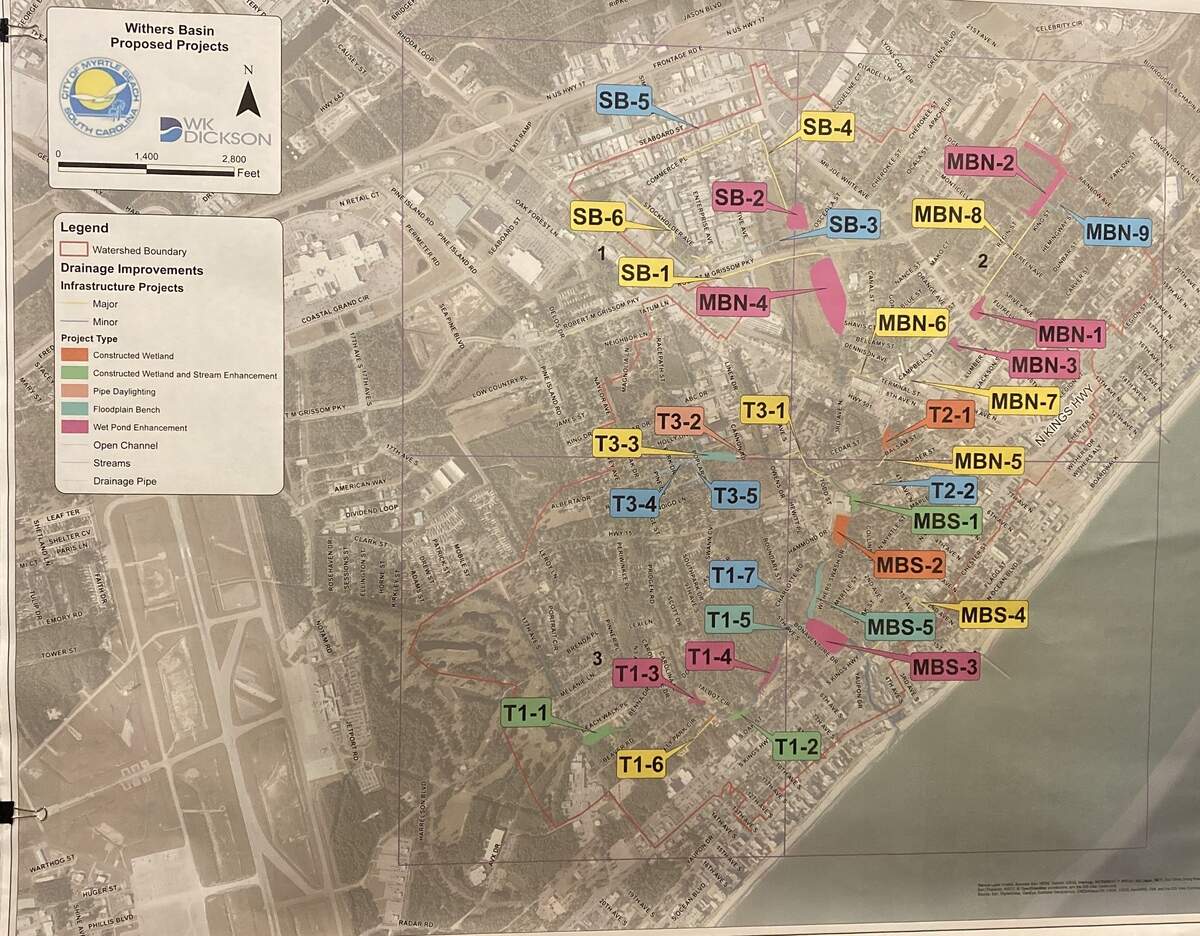
The firm is proposing 16 water quality treatment projects, at the cost of $7.7 million, that will focus on enhancing existing ponds with wetland features, creating new wetland facilities, buffer restoration and floodplain reconnection.
“Floodplain reconnection is really re-establishing those natural areas where when you have rainfall and runoff, that it could infiltrate into the floodplain before moving downstream,” Murray said. “The more that we can distribute projects throughout the watershed, we’re then able to treat stormwater before it becomes a problem further down the stream.”
Murray said the projects will focus on residential areas, noting that those areas are often a catalyst for high amounts of bacteria due to pet and human waste.
“We know from a previous study in 2012 that we do have canine influence in Withers Swash,” Curry said during the Beach Committee meeting. “We could all pick up and do a better job with that.”
Curry also noted that while the water quality treatment projects would provide a 50 percent reduction in bacteria and a 60 to 70 percent pollutant reduction, she said the overall measurement of bacteria will never reach zero.
Murray also discussed 11 major infrastructure projects that would improve water quantity through large culvert and pipe infrastructure adjustments to reduce flooding in several areas near Seaboard Street. Those projects would cost roughly $11.4 million in construction, which the city would need to hire an outside contractor for, Curry said.
“Those projects are focused on where we have identified flood concerns,” Murray said. “Recognizing improvements would allow better drainage of that system so that the water can get out.”
Additionally, the firm is proposing spending $3.5 million on seven minor infrastructure projects to improve water quantity. Murray said those projects would look at smaller pipe replacement, ditch maintenance, roadside channels and swells.
Murray added the construction could be handled by city crews, which would reduce the overall cost of the project.
With the city reviewing the proposed capital projects, Murray suggested methods to reduce the chance of bacteria and pollutants contaminating the water, including picking up pet waste and maintaining ponds, wetlands and infrastructure.
“The more mechanisms that we can add to the existing ponds will again enhance that pollutant removal,” Murray said.
He also suggested the city identify sanitary sewer sources through smoke testing and dry weather monitoring. While the testing would be costly, according to Curry, it would allow the city to track where the bacteria is stemming from. Curry said it would aid in managing the bacteria source.
Next steps
With WK Dickson finalizing its study, the city will next be tasked with pursuing grant funding opportunities to implement portions of the project.
‘We want to start implementing solutions,” Murray said. “The city is very active in applying for grant funding and trying to find opportunities to leverage the city’s resources with other funds that may be available so we can implement these.”
Education and policy modifications will also take priority when implementing the series of changes to the water basin.
“There’s going to need to be some policy issues that (city) council is going to need to deal with and some education that we’ll need to do,” Pedersen said.