Meet the candidates running for Myrtle Beach City Council
It’s that time of the year again when Myrtle Beach residents head to the ballots to vote for the candidates vying for a seat on the Myrtle Beach City Council.
Myrtle Beach has seven candidates vying for three council positions, including incumbents Mary Jeffcoat, Phil Render and Michael Chestnut, currently serving as Mayor Pro Tempore. Their challengers include former mayoral candidate Ed Carey, former councilman Wayne Gray, retired business owner Charles Gasque and community activist John Krajc.
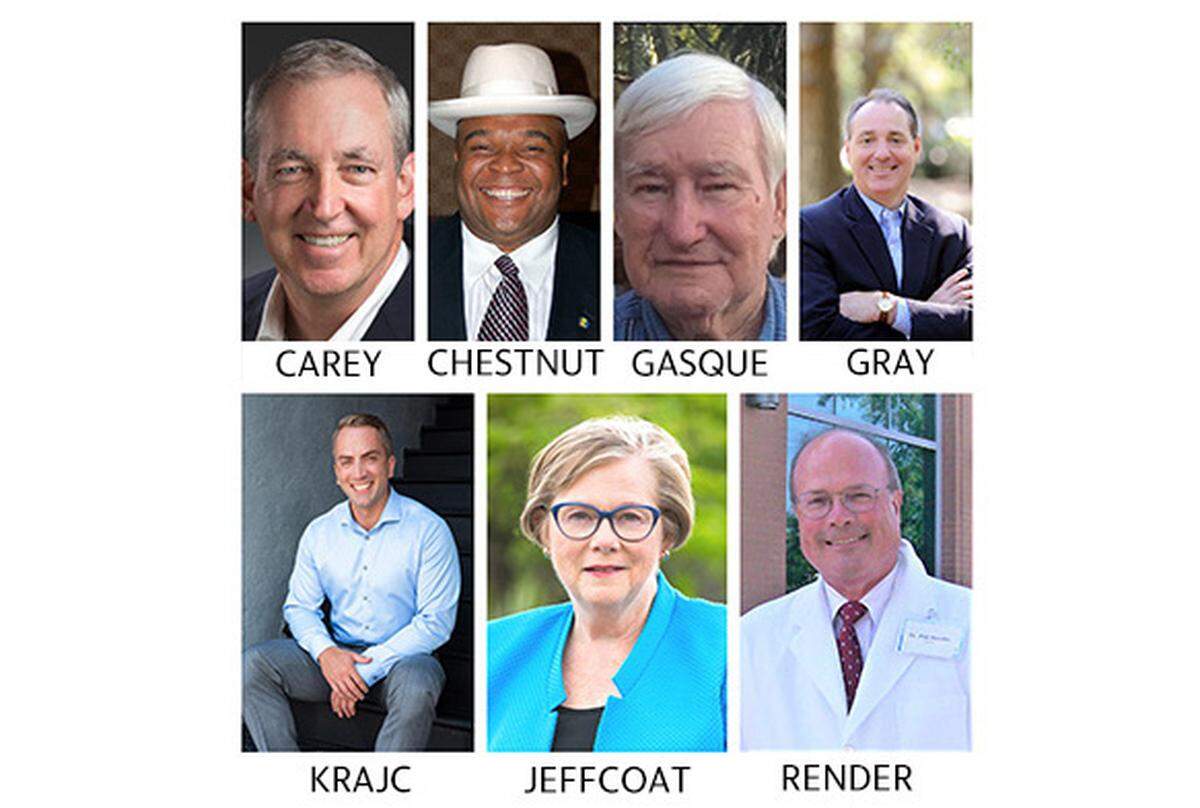
City council members represent the entire city, not individual districts in its non-partisan election on Nov. 5. The ballot will list all of the names and voters can pick their top three.
The Sun News reached out to each candidate, providing a list of questions for them to answer in their own words. Answers have not been edited for grammar but some were shortened for space.
Question: City Council has spent years crafting its Downtown Master Plan to rejuvenate the Superblock into a walkable and lively destination. With plans already underway to revitalize downtown, do you think the city’s current plan is both beneficial and profitable for the future of Myrtle Beach?
Edward Carey: City Council “has spent years crafting a Master Plan to rejuvenate the Superblock into a walkable and lively destination” is proof of how far our City government has strayed from its purpose. It’s high time that City government get its priorities in order: safe streets, safe homes and safe places to shop, dine, stay and play must always come first. Then clean streets, neighborhoods, water, sewer and - to ensure our tourism life-line continues - clean beaches and water. It’s time to focus - to perform our civic duties for residents and visitors alike - and leave the “rejuvenating” to the private sector. It is NOT up to the City Government to decide what plan is “both beneficial and profitable!” Having a “VISION” for the future of this any town makes sense. But if the private sector wants to stray from any “plan,” that’s their job! Before we add $Millions of taxpayer dollars to our $200 Million debt, let’s have the Chamber ask resident and especially tourists: “How often do you visit the “superblock” when you’re in Myrtle Beach and, if we rejuvenated it, would it be a significant reason to visit Myrtle Beach?”
Mike Chestnut: Let me just say that over the passed several years Downtown Redevelopment has been something that council has been trying to address now that we have a master plan i am see it come to life.
Charles Gasque: I am glad to see something happening in this area. However, I FEEL IF LAW AND ORDER WOULD HAVE BEEN MAINTAINED in the first place, the owners of the properties could have kept it alive and the DRC would’ve never been created. It would have never needed become an Opportunity zone, because it should have remained successful as it had been since Myrtle Beach was formed. The City has successfully moved downtown TO Market Common. They are the ones using the slogan “Myrtle Beach’s Uptown Downtown”. I am not knocking that area, i love the Market Common area, I am just stating what is and has happened. With that being said, I am truly happy to see things starting to happen and with law and order the super block will thrive again!
Wayne Gray: In my previous service, I recommended that we consider locating public purpose uses like the library, museum’s, joint city / county office complex in and around the superblock that will generate activity benefiting the general area from the new construction and development especially with the re-aligning of Highway 501 which I supported as a member of the Ride III committee representing the city. These uses can spur private development. There are other components of the master plan that are encouraging such as the central plaza that could be in the center of this municipal complex and improvements to major road corridors. There are other projects that I do not believe are justifiable such as a new city hall (do not need and not a wise use of tax-payer’s dollars) on the new re-aligned 501 corridor / Main Street. I will also ad that a major component of transformative, meaningful re-development in this area is the re-purposing of the Pavilion property into a vibrant use which is a critical anchor site in the historic downtown and amusement district.
Mary Jeffcoat: In January 2018, we began a community-wide conversation to get ideas for what we now call the Downtown Master Plan. Just under two years in the making, this plan already is in the implementation phase. Because of historic tax credits and other tax incentives, we have five new establishments committed to opening in the new downtown Arts and Innovation District: a construction company, a co-working space, a micro-brewery, an event space and a performing arts center. So, yes, our plan is not only beneficial and profitable for the future of Myrtle Beach, but this revitalization will help make our downtown area safer. The new town square will house our new library, the children’s museum and, perhaps, our art museum. And, the plan calls for residential units above the first-floor retail and nonprofit spaces. Our plan is based both on what our residents and local businesses told us they want, as well as what we have seen work successfully in other cities.
John Krajc: I fully support the City’s recent version of the Master Plan that City Council voted on in March. It’s also encouraging to see that CCU has taken a huge first step into it. For years, I have worked with fellow volunteers to improve downtown with projects like adding murals to buildings, landscaping and beautification, creating special events, and promoting the arts. When Brenda Bethune became Mayor, our efforts and the efforts of the City began to really make headway into revitalizing downtown. We need to continue to invest in public-private partnerships in our downtown area to ensure the future of our city is a bright one.
Phil Render: A revitalized Downtown Myrtle Beach is pivotal in our city’s future economic development. The present Council has a dream plan, but without a defined funding model or a Council project priority list. The city is considering allocating millions of public dollars in infrastructure alone. I am eager to hammer out the funding details with emphasis on the ROI, return on public investment.
Since March, Myrtle Beach and Horry County have been at odds over the allocation of the hospitality tax, with the city spending upwards of $400,000 in legal fees and the feud threatening the fate of the construction of I-73.
What do you think is a fair compromise? And how do you plan on working with Horry County to reach a swift resolution?
Carey: Governments, like businesses and individuals, often find themselves at odds. The problems are threefold. First, instead of wasting almost $1/2 Million on lawyers, our City Council leaders should have met face-to-face with Horry County and hammered out a deal - or at the least, try. This kind of ridiculous standoff is expensive, wasteful and an example of the arrogance of power than infects government at every level. Second, I’m not particularly worried about threatening the fate of I-73 because the money raised from more taxes on our cities won’t come close to enough to build that road - it “might” provide up to $250 million over the next ten years just for OUR portion. Where the balance of $2.5 - $4 billion will come from remains a mystery. A fair compromise would be to have the two entities agree to table the entire deal for at least a year and work TOGETHER on a workable alternative. I would work overtime to encourage our City Council and management team to work directly with Horry County - they’re awaiting reasonable people to reach a reasonable resolution!
Chestnut: NO comment on the law suite, As to I 73 my record speak for it self. We are a lot closer than you think.
Gasque: I think that a fair compromise is to place I-73 on the back burner until we can acquire federal funding to build it. Right now the road stops at the county line, no other counties are on board. So right now until those things change, we need to spend some of the money we have already collected, for what the money was originally intended for. This is improving our existing roads and infrastructure. For example we could six lane 501. It is completely imperative that the city and the county work together. I would be more than willing to reach across and work with Horry County Council members in order to restore the integrity of our relationship.
Gray: This is an issue where I differ with the approach of the existing city council and candidates. While I concur that there are equally important program services such as public safety and capital projects within the city’s jurisdiction in addition to roads like the I-73 effort, our citizens are best served by our local officials working through the differences to obtain a fair compromise for all concerned. The city’s approach will reduce total tax collections by $15 million annually and it appears to be no desire for a local resolution by the current city council. I plan to recommend that we appoint representatives of each governmental bodies along with appropriate staff to start this conversation. If we speak in a unified voice between residents, businesses and elected officials, the General Assembly will structure the tax policy that provides the most benefit.
Jeffcoat: The City has asked the County to stop collecting an illegal tax. The current law suit deals with this dispute. As a current City Council Member, I am bound by a confidentiality agreement not to discuss or disclose our mediation efforts, but I can say that we are doing everything we can to resolve this disagreement as soon as possible. On the I-73 issue, I support the construction of I-73 and am committed to helping see it built. I also support fair and equitable distribution of our state and federal tax dollars. Our residents and visitors currently pay state and federal gas taxes, and have been paying these taxes for decades. Our gas taxes have been and are being used to build interstates in and around Charleston, Greenville, Spartanburg, Columbia, and Rock Hill. None of these municipalities have helped fund their interstates with local taxes. My question, and I hope a question others will be asking, is “Why are Myrtle Beach and other Horry County cities being asked to help fund an interstate with local taxes, which are supposed to be used for local infrastructure, public safety and other local needs, when no other city in South Carolina has had to fund their interstates?”
Krajc: I’m not running for Horry County Council; I’m running for Myrtle Beach City Council. I’m running to protect the taxpayers in the City of Myrtle Beach. We have been sending city taxpayer money to the County only to find out they were allocating funds for things other than I-73 throughout other parts of the county. I do believe relationships are essential and we need to work together, but there has to be a better way to allocate the funds where they belong - the construction of I-73.
Render: During my public service I have been viewed by Myrtle Beach residents as the voice of reason, stability and civility on the body. Presently, Council while maintaining situational awareness, discussions with Horry County are in mediation thus limiting comment by elected officials. On a separate issue I-73, by Motion 2019-35, passed on March 12, 2019, Myrtle Beach City Council expressed the openness and desire to enter negotiations in order to establish a local government revenue steam for the construction of I-73.
How do you plan to improve public safety to reduce crime in the downtown area and ensure the safety of both residents and tourists?
Carey: This one is simple - not easy, mind you, but simple. It requires just two things: a) a knowledge of the function and purpose of government, and b) the will to change. Hiring 10 more police officers a year is simply not good enough: people will become victims of crime, of drugs, of sex trafficking … and even of murder. We have no choice but to carve a significant percentage of taxpayer funds now being funneled to and through the Myrtle Beach Chamber and send it instead to cover public safety. The property tax rebate would stay in place, of course, but the USE of the TDF funds must shift from some 90% for tourism advertising to $Millions useable for police, fire, rescue and other crime prevention methods not in 7 years - but now. THAT is the JOB as City government!
Chestnut: I plan to make sure that the police dept ,has the man power it need to keep our residents and business community/tourists safe,such as our plan to add 10 new officer a year for the next 7 years.
Gasque: I don’t like to hear the terms Dirty Myrtle or Murder Beach when people speak of our city. We have a great police chief and staff, and we need to let them enforce our laws and banish the bad reputation that are city has quite frankly earned. Right now, you can come to MB and do what you want, because all you are going to get is a warning or slap on the wrist! Once we change this, this city will get its family friendly identity back and these nasty names will become distant memories. I am a strong believer in community policing, and I would like to see our officers out of their vehicles more often when out patrolling. In short, it does not matter how many officers we have if laws are not adequately enforced.
Gray: Public safety is my number one priority and I am proud that I was a part of the council that developed the public safety retention and recruitment plan in 2017 which has led to 800+ security camera’s, body camera’s for police officers, license plate readers on major entry corridors and increased pay for police officers. Helping to fund this initiative is a recommendation I made of re-allocating some accommodations tax funds for public safety that were previously used for out of market advertising. Public safety must remain a number one priority by continuing to invest in more technology, improved infrastructure and street lighting and additional officers.
Jeffcoat: The violent crime rate declined by double digits in Myrtle Beach over the last two years. If you commit a crime in our city, you will be caught. Two years ago, we put a plan in place that makes Public Safety our city’s top priority. We are putting more police officers on the street, adding 10 new officers a year for seven years. We have continued the surveillance camera program and now have over 800 cameras around town. We added license plate readers at the main entrances to Myrtle Beach and we are catching criminals before they have a chance to commit crimes in our community. We are paying our police officers well and, where we use to have dozens of openings in our police department, we now are almost fully staffed. We are revitalizing our downtown area which will attract visitors and residents, making the area both safer and economically vibrant.
Krajc: The massive effort that has been undertaken in the past two years by our Mayor and Chief Prock has caused our crime rate to drop by double-digits. There is still more work to be done and I want to work with City Council to ensure we have the resources needed to provide solutions like better lighting, more street cameras, and be able to train and attract the best police officers.
Render: Continue to support systemic public safety enhancements. The City Council has increased resource deployment by 31%, adding 10 new officers a year since 2015 election. There has also been technology upgrades including camera deployment citywide and a renewed emphasis on neighbor involvement with public safety officers spending more time in schools and neighborhoods with our young people.
Homelessness, prostitution and drug use has run rampant in certain sections of Myrtle Beach. What can city leaders do to change the city’s image and clean up these sections of the city?
Carey: One thing is certain: fixing up the “superblock” or painting murals on “downtown walls and sidewalks” won’t solve any of those problems. First, we must strictly enforce the law — with more police so that our “tourism” advertising can boast about us being the “safest” beach — not just the prettiest. Second, regardless of what “homeless people” say they will or won’t do, it must be AGAINST the LAW to live (and all that means) outdoors on public property — just as it is AGAINST the LAW to live (and all that means) on PRIVATE PROPERTY. Perhaps we can convert some of our older structures into tiny apartments? It will be CHEAPER to house and feed these poor folks than to deal with the cost of NOT taking care of them.
Chestnut: we must continue work with the diffrent agency in our city to address the issues of Homelessness,work with neighbor hoods and police dept ,code enforcement clean up area that attract bad elements .....Quality of life court is going to be a step in the wright direction.
Gasque: Primarily on the south end, we are putting up with homeless people laying all over town, drug dealing and prostitution, and we are allowing panhandlers to harass and run off our tourists. We have become a destination city for people who want to live this type of lifestyle. This reputation has to change. We have to work something out with Horry County to cover the donut holes within our city limits. This can be done without purchasing land or forcing annexation, instead we need establish cross jurisdiction policing. The key to this issue is consequences. Lawbreakers will take heed to warnings if they know real consequences are next. We need to our direct focus on our families who are desperately seeking help. I want our resources to go to those who want out of their situation. I live on the south end. I know the issues it faces.
Gray: It requires a multi-faceted approach of strict law enforcement and zoning and building code enforcement of those violating the law, a collaborative support system between non-profits, hospitals, and city, county and state governments to provide assistance to those in need. The city must also establish an environment of good government that fosters and supports economic growth and new development creating job growth which will displace this negative element as well. We cannot deny the challenges exist and we must all share in the efforts of improving this societal ill.
Jeffcoat: The Myrtle Beach Police Department is constantly working with our neighborhoods when these issues are reported, and we increase patrol and enforcement efforts when needed. But law enforcement alone will not solve these problems. So, we took the lead in creating a partnership with other cities, counties and our hospitals to develop a comprehensive, two-county plan to address the opioid epidemic. No other community has taken this approach and the state of South Carolina has given us a $500,000 grant to implement this plan, which includes law enforcement, prevention, education, treatment, etc. Helping people with these complex problems is hard work and we are partnering with other agencies in the community to better serve them.
Krajc: For over two decades, long-time city council members have sat by and watched these areas slip further and further into decline. The number one duty of government is the safety of its citizens and visitors and we are never going to succeed in revitalizing our City if people don’t feel safe. I hope to work with fellow city leaders to create a program that encourages the homeless to work on beautification projects that will benefit everyone in the city. This will be one of my number one priorities when I serve on City Council.
Render: As crime continues to fall in many business areas due to business expansion and increased policing efforts, violent crime was down 17% in 2017 and 26% in 2018, fewer public resources will be required in those redeveloped areas thus making available more assets to be deployed in all Myrtle Beach neighborhood settings. Additionally, with continued city debt retirement, such as the the convention center and baseball stadium being paid off in 2017 and 2018, the city will have more law enforcement resources to invest citywide.