
‘Life is at a stand still’: Some homeowners may have to move due to RIDE III project
Horry County resident Christine Williams is most likely going to be one of at least six homeowners in the Sandridge Community who may have to move because of a RIDE III project.
A Conway native, Williams said she only moved into her house a couple of years ago. No one told her when she moved that the Conway Perimeter Road Phase II could affect her property. While road construction will not begin until 2023, Williams learned on Thursday it will probably run through her Conway home.
“If there wasn’t something I could do I would get upset, but there is nothing I can do. I just pray they give me what I need to find a new home.,” she said. “For now until 2023, my life is at a stand still.”
On Thursday, representatives from the South Carolina Department of Transportation presented conceptual plans of a preferred route of what the road, Conway Perimeter Road Phase II, will most likely take. It runs from Highway 701, curves up to Dirty Branch Road and connects with Highway 378.
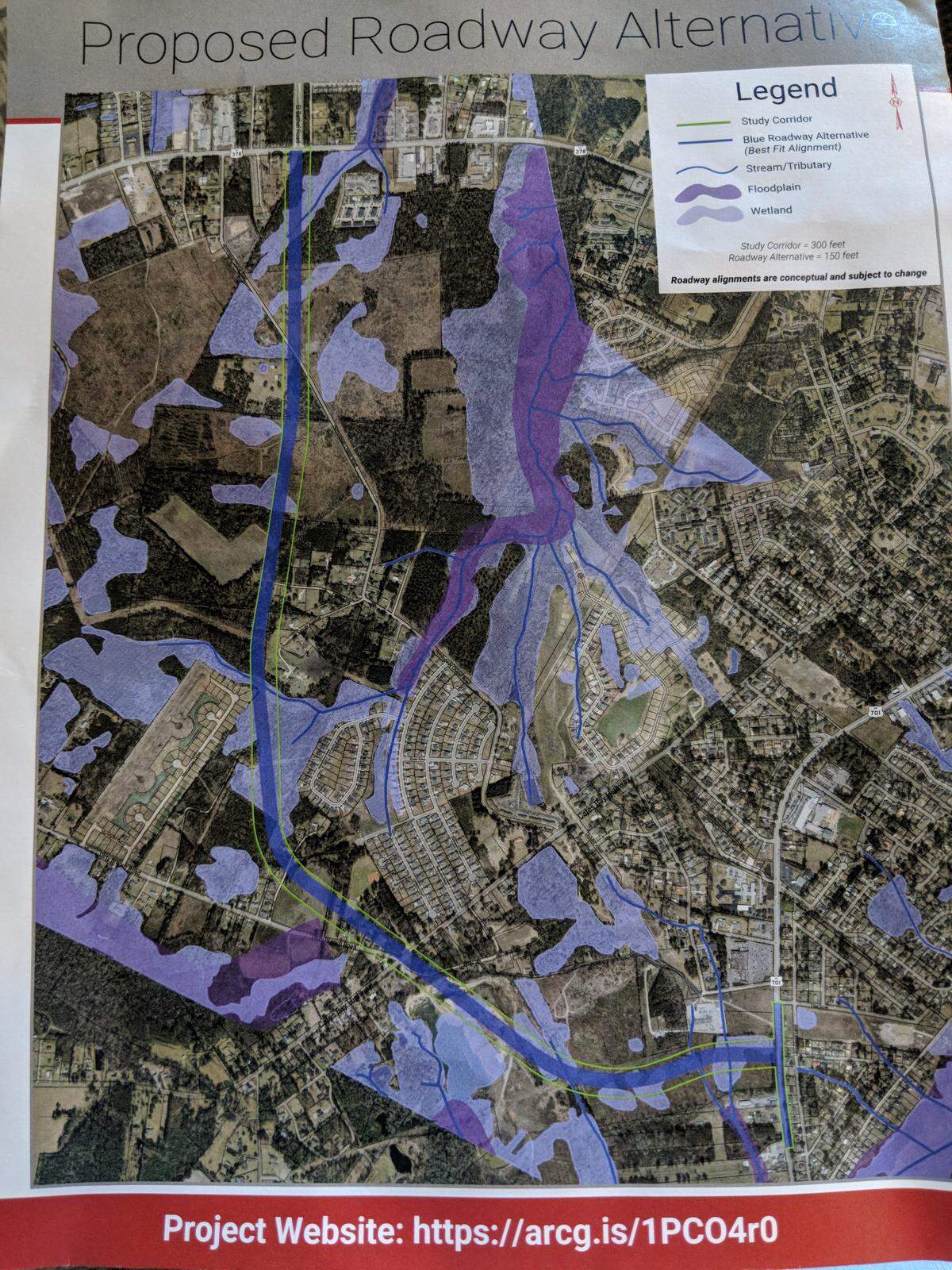
The overall project was approved by Horry County voters as a part of the 2016 RIDE III referendum. It’s intent is to give travelers an alternative route to travel around Conway without getting on the traffic-heavy U.S. Highway 501 that runs through the city.
SCDOT is only helping with the planning, the project ultimately belongs to Horry County.
The impact
The Thursday meeting was for the SCDOT representatives to present the route the new road is going to take and get public feedback. Stacey Johnson with SCDOT said his agency is looking for the response from the public about the area and what the road could affect.
Horry County Council Member Orton Bellamy and Chair Johnny Gardner attended the meeting to speak with the public and to make sure this road’s impact is as small as possible.
Officials picked a preferred route because it would have the least effect on property owners. Other corridors would have bumped up against historically black-owned homes, churches and a graveyard within the Sandridge community.
In total, the preferred route predicts 54 properties will be effected by the road, with only six of those requiring the owner relocate. In addition eight acres of wetlands will also be effected but none of it will be in designated flood zones, according to information presented to the public on Thursday.
No church or graveyard will be directly torn down or moved by any of the proposed routes.
While some details could change in the coming months, the picked corridor gives a good idea of who will lose land or have to move before construction begins. Alternatives to the preferred route could lead to four more homes being relocated.
What’s next?
Community activist Cedric Blain-Spain said nothing is final, and he is going to meet with the community on Aug. 22 to figure out what to do next and how to support the homeowners affected.
He said it falls on Horry County Council to protect its residents and go back to the drawing board on this project.
“We know it’s not over,” Blain-Spain said. “At some point someone, the county council members, SCDOT or somebody tonight after seeing tonight, the public comment and written statements will go back to the drawing board and make a better plan. Nothing is ever final.”
It will still be some time before dirt starts to move on the Perimeter Road project. Right of ways must be purchased from the property owners, and all the design work still needs to be done. Johnson said after some more work is done, it’ll take about one-to-two years to purchase the land.
SCDOT policy says that people who will lose property due to the road’s construction are entitled to “fair, uniform and equitable treatment” and will “not suffer disproportionate injuries as a result of projects designed for the benefit of the public as a whole.”
People who are entirely displaced by a road project are paid for the loss of property and some moving costs, according to SCDOT policy. In addition, sufficient time must be given for a displaced homeowner to find new lodging.
“Once we know what our full impacts will be, we will reach out to those property owners,” Johnson said.
This story was originally published August 8, 2019 at 7:33 PM.