
County councilmen denied having motion to suspend administrator. Emails say they did.
The rumored plan to suspend Horry County Administrator Chris Eldridge is true, but the four county councilmen who should have known about the motion denied knowledge or possession of it, putting the county at risk of violating the Freedom of Information Act.
On Friday Jan. 4 at 8:23 a.m., hours before a special meeting of council happened, Horry County Councilman Al Allen sent an email from a personal account to council members Johnny Vaught and Danny Hardee, as well as County Chair Johnny Gardner.
The email’s subject line was “Motion to Suspend copy. docx.” The motion moved to suspend Eldridge with pay until the S.C. Law Enforcement Division completed a report into an alleged extortion attempt.
“In the interim, Council appoints County EOC Director Randy Webster as the Interim Administrator,” the proposed motion read. Webster declined to comment as to whether he had knowledge of the motion, saying he does not want to get caught up in what’s going on.
The Sun News acquired the documents through a Freedom of Information Act request.
‘I have none’
On Jan. 4, local TV station WPDE filed a FOIA request trying to confirm if any communication existed concerning an attempt to suspend Eldridge and name Webster as interim administrator.
Their request read:
“Access to and copies of any and all emails or records that show some county council members planned to vote to suspend Eldridge with pay and install Horry County Emergency Management Director Randy Webster as interim administrator.”
According to The Sun News’ open records request for emails, Allen, Vaught and Hardee all denied having any documentation.
“I have none,” Allen wrote in a response, again from his personal email, to Horry County Spokesperson Kelly Moore, who’s charged with managing records requests.
“I don’t have any,” Hardee wrote.
“I don’t have anything,” Vaught wrote.
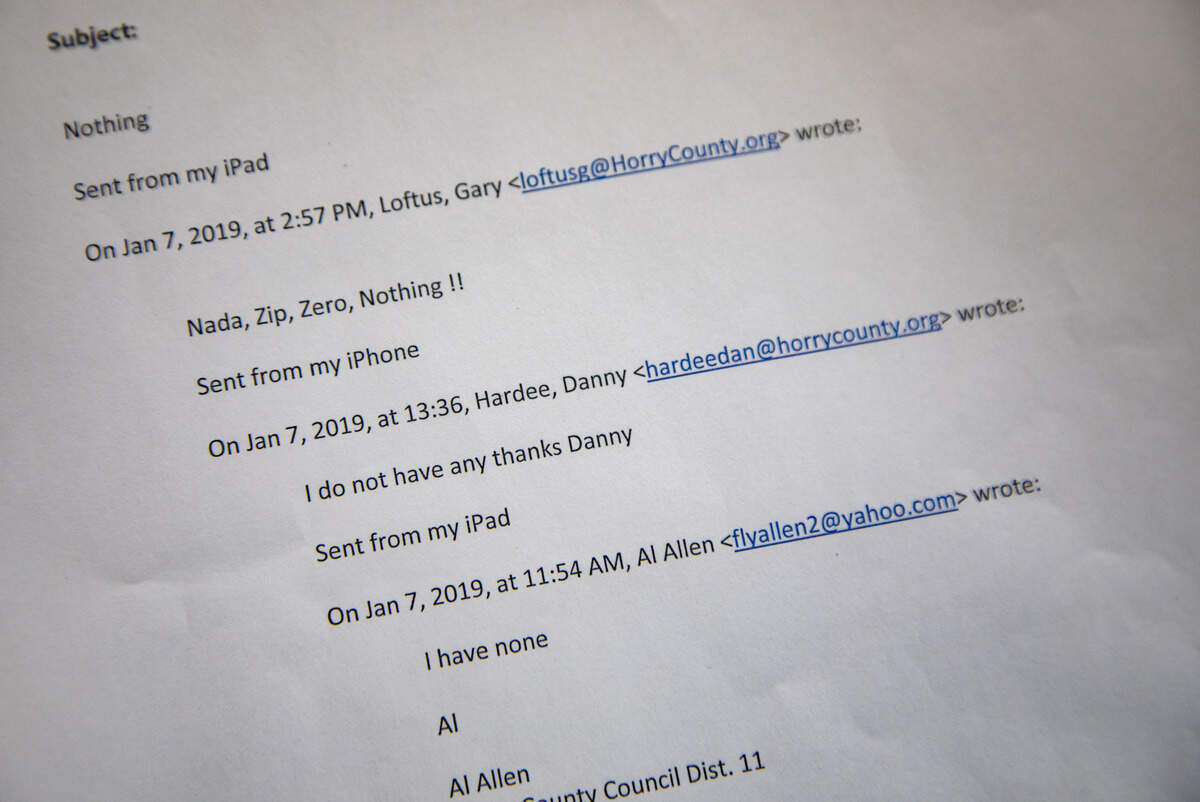
Confronted with the discrepancy by The Sun News: Hardee said he didn’t remember receiving the proposed motion; Vaught said he got it but didn’t think it was responsive to the FOIA request; Allen said he was asked to create it and sent it to the council members, but he no longer has record of it; and Gardner claims he never saw it and plans to respond to the request if he has it.
Gardner, Allen, Hardee and Vaught are required by S.C.’s open records law to give the document to WPDE.
Council responses
In an initial call Friday morning, Vaught said he recalled seeing Allen’s email, but quickly deleted it because he wasn’t in favor of it. He also said he wasn’t sure why Allen sent it specifically to him, Hardee and Gardner, but he suspected it was because they were committee chairmen.
However, Allen said Vaught asked him to produce the document, then got a constituent — who Allen refused to disclose — to draft it.
When The Sun News asked Vaught about the claim, Vaught said “it’s possible” it happened that way, but he did not specifically recall it.
Allen admitted to sending the email, but said he could not find it when responding to WPDE’s FOIA request.
Allen said he did not delete or remove the email from his records.
“I was asked if I had a record,” he said. “I went back and searched, and I didn’t have anything.”
Vaught said he deleted it, but didn’t claim the deletion was why he denied WPDE’s request. He said he read the request to specifically mean anything showing he planned to vote to suspend Eldridge.
“I value the FOIA process,” he said. “… I’d rather things be totally open.”
Vaught later said he believed that, if council wanted to take any action against Eldridge, suspending him with pay would be the only fair option. He qualified that statement by clarifying that he never intended to make any such motion, despite the fact that Allen says Vaught was the one who requested it.
Hardee said he recalled verbally receiving information concerning Eldridge’s possible suspension, but doesn’t remember ever receiving Allen’s email.
“I don’t remember getting it,” he said. “I’m not saying I didn’t. I just don’t remember.”
Hardee received the email Friday morning and responded to TV’s records request on Monday.
He said he typically trashes any emails he doesn’t find pertinent.
Gardner said he was unaware of the email or any plan to replace Eldridge with Webster, although Gardner initially called the executive session to discuss Eldridge’s employment. He said knew he had a FOIA request to respond to on Friday, the deadline for WPDE’s request.
‘Shadow Government’
South Carolina Press Association Director Bill Rogers said those documents should be public since they are about the people’s business.
“We have a shadow government in South Carolina connected by private emails,” he said.
Rogers added that the use of private emails is an improper impediment to public accountability over elected officials and is becoming common practice.
The use of private emails, even if unintentional, is not illegal, but does make it more difficult to hold the public accountable.
Media lawyer Jay Bender said since the four council members are not a committee or enough members to constitute a quorum, it probably is not outright illegal, but still shows public business is being done privately without the ability for the public to know.
Vaught said he wasn’t sure whether Allen’s email was sent to his public or private address, but he would hand over emails from his private address if he felt they were responsive to a FOIA request.
Both accounts are linked on his iPad, he said, though he said he’d consider being more careful to only use his public email address for county business if it makes those emails more easily accessible through FOIA.
Since Hardee didn’t recall receiving the email, he couldn’t say whether it was sent to his public or private email address, but he said he has responded to fellow councilmen in the past using his private email if they sent something to that address.
Hardee added that he has nothing to hide, and he would have no problem with the public having access to his private email account.
Allen said between his business, county council and personal life he has many email accounts, phone numbers, cellphones and computers. Like his other council members, he said he sometimes sends something from the wrong email.
“I am in no way trying to hide something,” he said.
This isn’t the first example of private emails being used in Horry County. Allen last week posted emails on social media showing council members arguing over seating arrangements, and his response was from a private email address. While Council Clerk Pat Hartley started the thread just to send out the new seating chart, a debate ensued in an email chain with all council members tagged on.
Per the state’s FOIA law, electronic exchanges constituting a quorum counts as a public meeting and requires public notice — regardless if public or private emails are being used.
“No chance meeting, social meeting, or electronic communication may be used in circumvention of the spirit of requirements of this chapter to act upon a matter over which the public body has supervision, control, jurisdiction, or advisory power,” the law states.
‘The people’s business’
While not explicit at the time, it was understood that the Jan. 4 meeting was to talk about Eldridge’s employment following a leaked memo written by county attorney Arrigo Carotti regarding extortion claims against Gardner. The meeting stuck in procedural debate and no actions were taken.
“We have a county administrator that has made allegations against the new incoming chairman and against prominent citizens in this county without no factual evidence whatsoever,” Allen said in the meeting. “It’s time to for us to face this, get it behind us, and get about the people’s business.”
Hardee told The Sun News Friday that he was upset by the timing of Eldridge providing council members with Carotti’s memo.
“I just wanted questions asked; it could’ve been a coincidence,” he said, pointing out that the extortion allegations began Dec. 5, but he only received the memo Dec. 19, the night before Gardner’s swearing-in ceremony. “If I’d been in (Gardner’s) shoes, I’d be wondering about the timing.”
Gardner wondered why Carotti would send that memo days before his swearing-in ceremony.
The emailed motion was never presented to the full council or voted on during the Jan. 4 meeting. The four council members on the email would not have been enough to pass the motion, even if that was their intent. Allen voiced support that day to make the matter public but then voted to go into executive session. Vaught made a separate motion to go into executive session for a different reason.
Vaught said he wanted council members to be able to ask Eldridge and Carotti what exactly happened, and he was disappointed other council members didn’t want to talk about it.
According to spokesperson Thom Berry, SLED has not completed its report.
The three council members who knew about the motion are now all committee chairs, but they weren’t at the time of the email or proposed executive session. At Tuesday’s council meeting, council member Dennis DiSabato said he learned Hardee would be the chair of a committee he was promised.
DiSabato accused Gardner of doing “play along to get along” politics he ran against, citing the Jan. 4 meeting as a reason he was not given the chair position. Gardner said he did what he believed was best for the county and within his power as chair of council.
On Friday, Gardner insisted the email to suspend Eldridge had no impact on who he picked to be council committee chairs. Council Member Paul Prince, the only chair who did not receive the email, was picked by Gardner to chair the Transportation Committee.
Moore, the county’s spokesperson, said there isn’t a precedent of a council member not providing records that should be public. Initially, Moore’s office uses the trust system, requesting council members to hand over any relevant documents. She said for specific requests, like WPDE’s, it’s easier and cheaper to have council members produce it instead of sending it to the information technology department.
However, the information technology staff can go into the servers to research public emails if needed. But if an email is sent privately, and never passes through the county’s servers, they would have to rely on the sender or recipient to hand it over.
While four county council members had access to the document, several council members not originally copied on the email denied having seen it.
Harold Worley, one of the council’s senior-most members, said he had not heard of the effort before the meeting, and to this day has only heard rumors.
“No, absolutely not,” he said when asked about if he knew about any such motion existing.
Council Members Gary Loftus, Paul Prince, Tyler Servant, Cam Crawford, Bill Howard and DiSabato all said they had only heard rumors but were unable to confirm its validity.
By time of publication Council Member Orton Bellamy had not responded to The Sun News, but he was not on the original email and the Jan. 4 meeting was his first.
This story was originally published January 18, 2019 at 1:26 PM.