Enrollment declined in Horry County elementary schools as growth slows in district
Horry County Schools are seeing a decline in enrollment among elementary schools for the first time in at least 30 years as overall growth in the district isn’t as high as anticipated.
The 2018-19 enrollment report, which compiles average daily attendance during the first 45 days of the school year, shows the district added 131 students total from last year, while enrollment declined by 299 students in grades K-5.
Joe Burch, the district’s planning coordinator, said this is the first time the district hasn’t increased its elementary school enrollment since at least 1988, which is as far back as he’s compiled data.
Middle school grades (6-8) accounted for the majority of the district’s growth with an additional 402 students, while high school grades (9-12) added 28 students.
Burch said these numbers are compiled every year, and they’re important to consider as officials plan for hiring additional teachers, renovating existing schools and building new ones.
The district has been increasing at an annual rate of more than 940 students the previous four years, and Burch said he expected a slowdown may be coming this year, but nothing this drastic.
Burch didn’t know precisely what led to the slower-than-expected growth, but he’s noticed a flattened birth rate among residents and, though migration to the county remains high, those migrating aren’t necessarily bringing young children.
He noted that the report is preliminary as his office further analyzes the numbers by individual schools to help determine which buildings are at or above recommended capacity.
The numbers are particularly relevant as Horry County’s school board is trying to move forward with its five-year capital plan, which is currently projected to cost more than $754 million.
The board had access to the report prior to its Dec. 3 meeting when its members determined which projects they wanted to prioritize.
Based on the results of the meeting, the board’s priorities include modular classrooms, renovating St. James High School and Myrtle Beach High School, and replacing the Horry County Education Center and Whittemore Park Middle School.
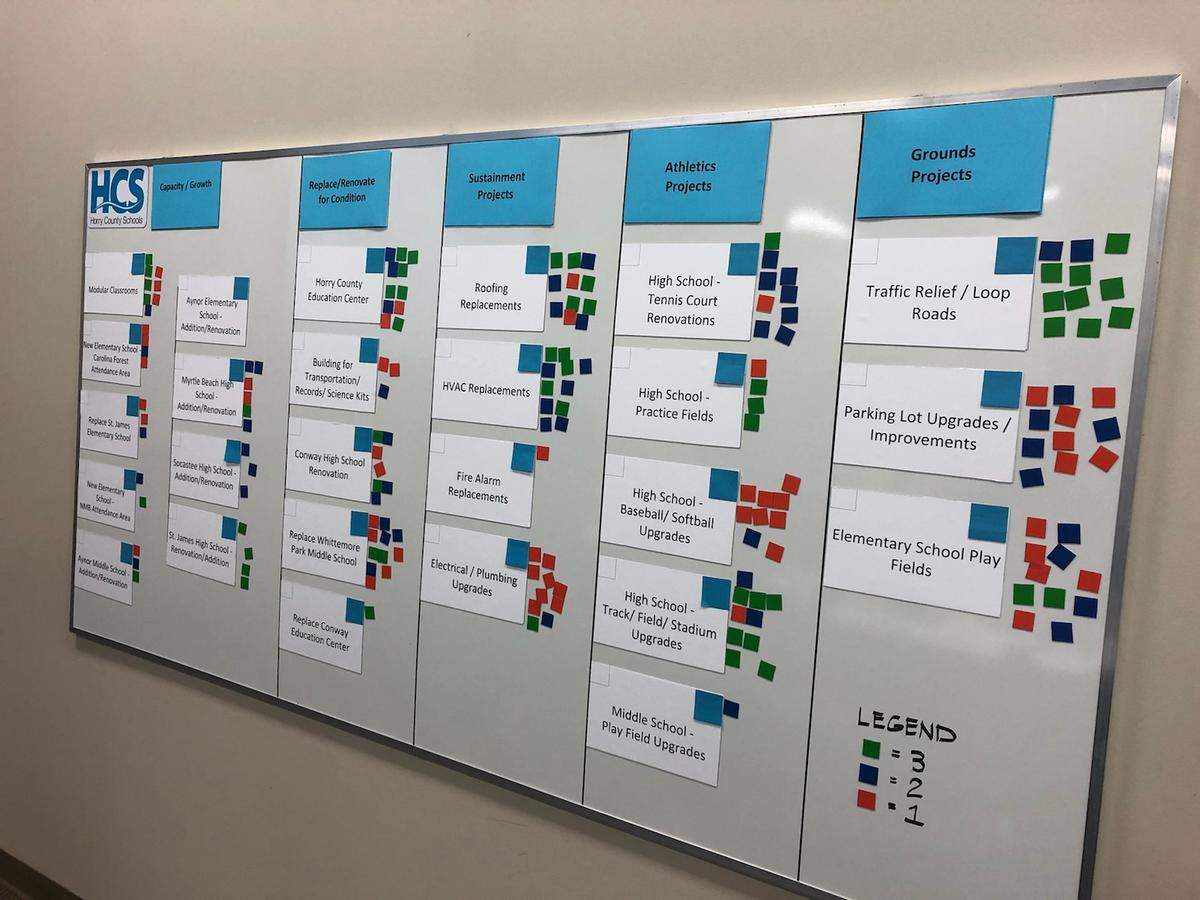
Board member Ray Winters said he was happy that knowing the board’s priorities will allow them to move forward, but he was slightly disappointed that building a new elementary school in the Carolina Forest area wasn’t among the top priorities.
Carolina Forest attendance area added 298 students this year, the most by far of any attendance area, according to the report, which showed St. James (53 students), Socastee (37) and North Myrtle Beach (25) as the only other areas with an increase. Aynor saw the largest decrease, with 93 fewer students than 2017-18.
Carolina Forest has added 1,546 students since the 2013-14 school year, the report shows.
Board member Holly Heniford said she doesn’t doubt the report’s numbers, but she believes the slowed growth is merely “a blip.”
“I’m not paying attention to (these numbers),” she said. “Growth is coming.”
The report estimates enrollment in the district — which rose 10 percent in the past five years — to grow by 4 percent during the next five years, with a majority of that growth in the high school grades.
Heniford added that she wasn’t happy at all with how the Dec. 3 meeting concluded because the board did not prioritize any projects for the growth she sees coming in North Myrtle Beach.
Heniford, the only board member whose district includes North Myrtle Beach, said she’s done research on vested properties in the area and if even a small percentage of people moving into those properties bring a student, they could fill a whole new school.
The board is still trying to determine how to fund its capital plan, a decision that could be impacted by the slower growth as most state funding is awarded based on the number of students attending the district.
The South Carolina Department of Education’s latest revenue per pupil report shows the Horry County Schools was estimated to enroll 44,334 students this year with the state providing $4,960 per student.
That estimate is 1,407 students more than the district’s report shows are attending, which would equate to nearly $7 million less in funding.
John Gardner, the district’s chief financial officer, was not available to discuss the total financial impact of the slower growth.
This story was originally published December 6, 2018 at 9:02 AM.