
Giving drugs to drug addicts for recovery: Inside the growing controversy
Suboxone didn’t end Ellie Pcolar’s drug addiction, but she believes it significantly helped.
Arrested 18 times in the past 10 years, the 27-year-old said the drug helped wean her off her heroin addiction.
“I wouldn’t recommend it for everyone,” Pcolar said, now several months sober and working at a Conway bakery. “It’s another drug; it still gets you high, but it was amazing to not have to go out and buy heroin every day.”
However, Suboxone — a federally approved drug that treats opioid addiction — didn’t help Merissa Walden.
Walden was prescribed the drug on two separate occasions, but it never changed her addiction mindset.
“I knew I was going to get my next hit, it was just coming from a doctor,” she said of her “legal high.”
Walden has since been able to break her heroin addiction, regain custody of her two daughters and get involved in helping others recover, but she’s among many in the local recovery community — which is starting to see a reduction in overdose deaths — who express doubts about the effectiveness of Suboxone.
As the nation continues to grapple with the ever-worsening opioid epidemic, government officials and the medical community are increasingly pushing medication-assisted treatment — specifically Suboxone, which is the most accessible and cost-effective option. But many of those in the trenches of the crisis are wary of a solution they see as simply trading one drug for another.
‘It’s about harm reduction’
Standing at the front of an eight-person class, Dr. Victor Archambeau detailed the three approved methods of medication-assisted treatment: methadone, buprenorphine and naltrexone.
Methadone and buprenorphine are both addictive opioids themselves, though they’ve been effective in helping treat opioid addictions when distributed by a medical professional.
Naltrexone, often referenced by the brand name Vivitrol, blocks the opioid receptors in the brain, preventing a user from getting high from heroin or other opioids for 30-day periods.
Vivitrol, costing as much as $2,000 per shot, is cost prohibitive, Archambeau said.
Methadone, only allowed to be distributed in daily doses at federally approved clinics, is time prohibitive, he added.
Buprenorphine, the primary ingredient in Suboxone — the other being naloxone, another type of opioid blocker — is becoming the most widely used, he said, because it can be prescribed.
Restrictions still exist, as federally authorized doctors must take an online course and pass a test before being allowed to prescribe to a restricted patient load.
Archambeau’s allowed to have up to 100 patients with active Suboxone prescriptions, he said, as the federal government tries to stem a culture of overprescribing that helped lead to the current epidemic.
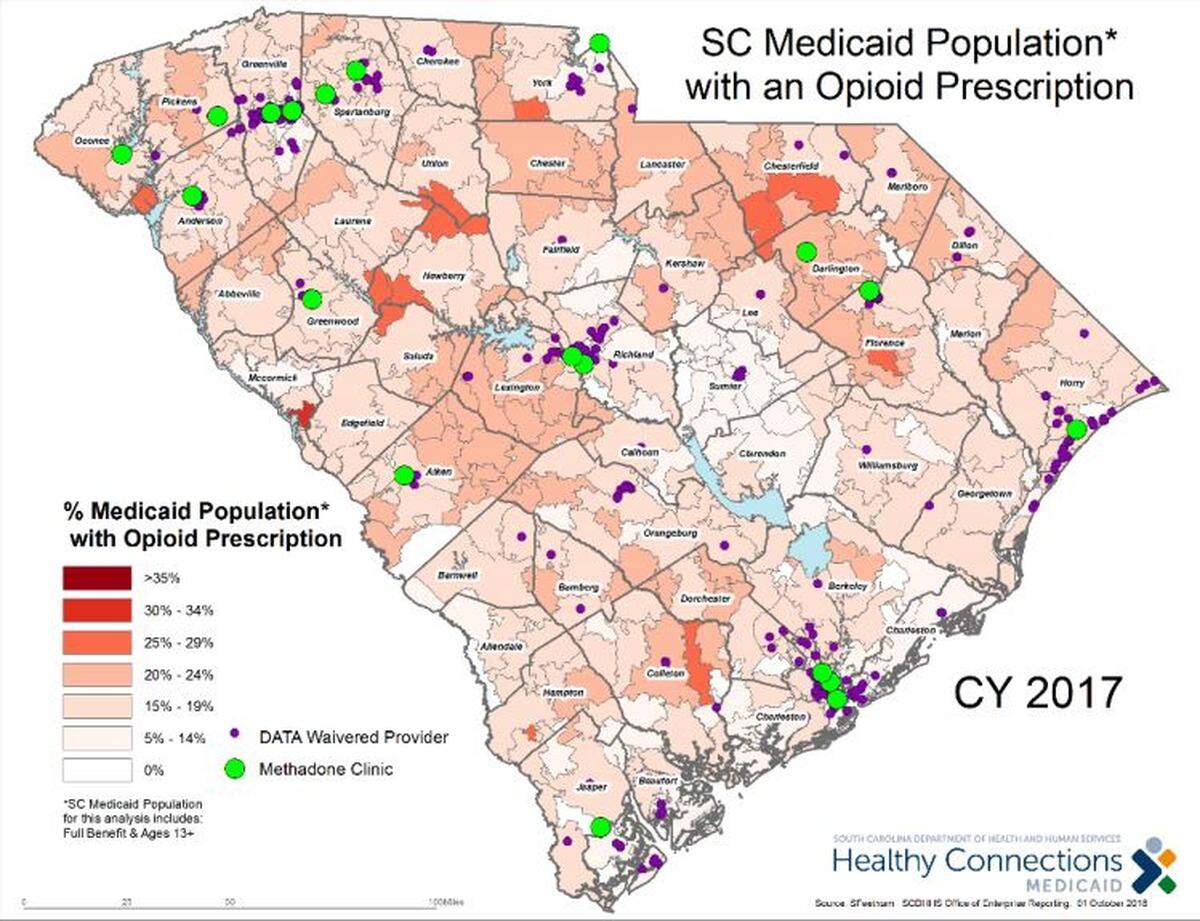
Only one methadone clinic, the Center of Hope of Myrtle Beach, is operating in the Grand Strand area while 42 local medical practitioners are authorized to prescribe Suboxone, according to the federal Substance Abuse and Mental Health Services Administration.
Archambeau, one of the authorized practitioners and chairman of a prominent local recovery organization, then asked his class of hopeful recovery coaches to name off family and friends they’ve lost due to addiction, first names only.
Within minutes, a list of 17 names is written on a large sheet of paper.
According to a Yale study, recovering opioid addicts on Suboxone are significantly more likely to still be in treatment after six months than one who detoxed through abstinence, Archambeau told his class.
“It’s about harm reduction,” he says, pointing back to the sheet of names, arguing that many on the list would still be alive today had they been prescribed Suboxone.
Medication-assisted treatment gets the money
Trying to slow the continued rise in drug overdose deaths nationwide, the federal government is allocating more money to address the crisis than ever before with more than $1 billion distributed to states this year.
The U.S. Department of Health and Human Services recently awarded more than $20.5 million to South Carolina to combat the opioid crisis, with more than $14 million of it earmarked for increasing access to medication-assisted treatment.
Sara Goldsby, director of the state’s Department of Alcohol and Other Drug Abuse Services, recently told state legislators on the House Opioid Abuse Prevention Study Committee that federal health officials are pushing medication-assisted treatment as the evidence-based treatment solution for opioid addiction.
“(HHS) has been very clear, detoxification into abstinence without medication support is not treatment,” she said.
That direction, supported by a majority of the medical community, is why South Carolina officials are pushing more resources into Suboxone access as they work to reverse rising death counts.
Data collected by the South Carolina Department of Health and Environmental Control shows opioid-involved deaths increased more than 21 percent statewide in 2017 — from 616 in 2016 to 748 in 2017.
Horry and Georgetown counties bucked that trend, seeing a combined 29 percent drop from 128 opioid-involved deaths in 2016 to 91 in 2017, according to DHEC’s data.
Goldsby said state officials are paying close attention to the progress made in Horry County, which was able to end its two-year run atop the state opioid overdose death numbers.
Preliminary data collected in 2018 suggests this encouraging trend may continue, as Horry County overdose deaths were down 15 percent through Aug. 1, according to deputy coroner Michelle McSpadden.
“They’re doing something right, and we want to pay close attention,” Goldsby said of the Grand Strand recovery community, which includes strong advocates and detractors of medication-assisted treatment among its leaders.
‘It’s taxpayer money going down the drain’
Even the staunchest advocates of Suboxone will admit it won’t work for everyone, just as its detractors will stipulate that it can be helpful for some, but rarely will you find someone in this community who won’t speak passionately one way or the other.
Archambeau, chairman of the Grand Strand’s chapter of Faces of Voices of Recovery, is chief among local proponents for medication-assisted treatment.
Known simply as “Doc” throughout the Grand Strand addiction and recovery community, Archambeau also works as a family practitioner for Tidelands Health.
“There’s really two schools of thought on (medication-assisted treatment),” Archambeau tells The Sun News. “Some are very opposed and others recognize its valid use, and the statistics are on the side of the latter.”
While the majority of the medical community might be lauding Suboxone, Dr. James Graham is warning that the long-term consequences of this push could be just as severe as the push for addictive pain medications, such as Xanax and Oxycodone, that helped lead to the current situation.
An addictions medicine specialist for nearly 40 years, Graham currently serves as medical director at Coastal Recovery Center, an intensive outpatient program in Myrtle Beach.
“It’s taxpayer money going down the drain,” Graham said, “a form of enabling by the government.”
Since Suboxone is an opiate, it alters the neuroreceptor site, and blocks people’s feelings, thus making it impossible to treat the underlying causes of addiction, he said.
Graham also pointed to Suboxone’s emergence as a street drug to bolster his claims against its effectiveness.
When Walden was kicked off her Suboxone prescription for failing a drug test, she went right back to heroin, she said, and even added a new favorite street drug: Suboxone.
Sgt. Jeremiah Beam, supervisor of Myrtle Beach Police Department’s Street Crimes Unit, said his squad has seen instances where heroin dealers also are selling Suboxone, which comes in orange pills or small, paper-thin strips.
“It’s $8 per strip from a doctor and $20 a strip off the street,” Walden said.
Mikayla Moskov, spokeswoman for Horry County Police Department, similarly said HCPD officers have noticed Suboxone illegally distributed, but it’s not very common.
Suboxone’s presence on the street is a legitimate concern, “but as far as street drugs go, it’s certainly less harmful and safer than heroin, fentanyl and dirty needles,” Archambeau said.
Fentanyl, a narcotic significantly stronger than heroin, was linked in 2017 to 362 overdose deaths in South Carolina, representing a 432 percent increase since 2014, according to DHEC.
Nalaxone, an opioid blocker, is built into Suboxone, making overdoses significantly less likely, Archambeau explained.
“(Suboxone) may be contributing to the problem,” he said, “but we’re never going to have a drug-free society, and this may be worth it.”
As the debate carries on in the medical community, the split has spilled over into all parts of the recovery community.
Several local recovery houses — residences for recovering addicts to focus on their sobriety — refuse to accept residents taking Suboxone. Pcolar currently lives in one such house, operated by Greater Love Home, which runs four women-only recovery houses in the county.
Diverting addicts from prison
Horry County’s drug treatment court won’t allow its participants to take the medication-assisted treatment route.
Fifteenth Judicial Solicitor Jimmy Richardson, who oversees the court, said he believes Suboxone is a good option, but he doesn’t want it “watering down” their program.
The federal government has been pushing to allow medication-assisted treatment in drug courts, Richardson said, but he worries it’s just “trading one drug for another.”
“It works for (them),” he says, nodding toward the courtroom, where 10 graduates just walked away from a combined 45 years of prison sentences.
Courtroom 3B in the Horry County Courthouse filled up quickly one August afternoon, but there was no high-profile case on the docket.
Ten convicted criminals were marched past balloon-toting friends and flower-holding family members, who were sure that their loved one would soon be free of their convictions.
That’s because these 10 were the latest of 362 to graduate from Horry County’s drug treatment court since its inception 13 years earlier.
Drug court personnel took turns introducing the graduates, their projected mugshots often looking nothing like the person sitting before the crowd that day.
Each graduate’s story of recovery was more inspiring than the last. One man was in and out of jail 15 times. A woman was awarded custody of her children. Another man, who began using drugs when he was 4 years old, was currently holding down a job as a kitchen supervisor for the first time in his life.
Friends and family gave teary-eyed speeches expressing how proud they were of the graduates and how excited they are for their futures.
The diversionary court program admits people that already have pleaded guilty and accepted a sentence; this group had a combined sentence of 45 years, which was dismissed.
The county had no idea what it was doing when they began the program 13 years ago with three clients, Candy Townsend, the county’s drug court director, told the crowd, but the goal has always been the same: help people beat addiction.
The court, on average, is working with 110 clients at a time, Townsend said.
Clients must get jobs and are drug tested three times per week, Richardson said, but they won’t kick someone out just for failing a test.
“We expect a drug addict to screw up,” he said, noting that they will place them in jail for a few days. “… The amount of jail time isn’t important. It’s the immediacy.”
Only about half of drug court participants make it to graduation, but those that do have an 88 percent “success rate,” which they calculate based on those that don’t reoffend within five years of graduation, Richardson said.
“I guarantee the recidivism rate (of Suboxone users) is not as good as drug court,” he said. “Suboxone is like a life jacket, which is a good thing, but at some point, you need to take it off and learn to swim.”
‘Recoveryism’
Archambeau calls the pushback against medication-assisted treatment a form of “recoveryism” — believing your version of recovery is the only way.
Recovery is a very individualized process, he said, and addicts’ varying successes or failures with Suboxone displays that observation.
In a community where anonymity has long been the norm, FAVOR and similar groups are working to help destroy cultural stigma by loudly showing anyone who will listen that addicts do recover and promote scientific consensus that addiction is a disease.
But with so many in the recovery community against medication-assisted treatment, FAVOR recently started Medication-Assisted Recovery Anonymous, a counseling and support group similar to Alcoholics Anonymous or Narcotics Anonymous, but specifically for those using prescribed medications to help break their addictions.
Nicole Cress, director of Grand Strand’s FAVOR chapter, said the new meeting fills a huge need as more people decide to try medication-assisted treatment and want to avoid feeling judged.
The number of patients the Department of Alcohol and Other Drug Abuse Services is financially supporting to receive medication-assisted treatment increased more than 200 percent from 695 in 2017 to 2,221 in 2018, according to Goldsby’s recent presentation to legislators.
As the department helps increase access to Suboxone, Goldsby assured legislators that those receiving the drug also will receive counseling, pointing to a program piloted in Horry County that is bringing the medical and recovery communities closer together.
Coaching recovery
A state grant, administered by the Medical University of South Carolina and used locally by Shoreline Behavioral Health Services, is working to get addicts into treatment as quickly as possible by pairing addicts with local peer support specialists, often referred to as recovery coaches.
The recovery coaches are addicts in “long-term recovery,” who received at least 40 hours of training, mostly done locally through FAVOR. They’ve been around the Grand Strand for many years, going wherever they felt the need was greatest, but only now are some being paid to work with local hospitals.
The pilot program, which began this year, is being employed in emergency departments at Tidelands Waccamaw Community Hospital and Grand Strand Medical Center.
Anyone who visits either emergency department will be asked several questions about substance use to determine whether they have a substance-use disorder, said John Coffin, executive director of Shoreline.
In previous years, anyone determined to have the disorder would then receive a referral for treatment. Under the pilot program, a clinician, with approval from the patient, may administer a single dose of Suboxone and refer them to a behavioral health provider that agrees to see them within 24 hours, Coffin said.
Studies have shown addicts often relapse four or five times after initially seeking treatment before sustaining recovery, Coffin said, but the risk of accidental death with the opioid crisis is so high that healthcare officials can’t risk letting opportunities pass to get addicts into treatment.
As part of the program, hospitals are staffed with recovery coaches, who immediately meet with the patients and follow up with them in their pursuit of recovery, whatever path that might take.
Ashley Capps, associate vice president of nursing operations at Tidelands Health, said the coaches have quickly become an important part of their team.
“Having that liaison connect with them right away, … real people, people that have walked that same line and been successful, it’s an amazing benefit,” she said.
Susan Shirley, one of about 30 local recovery coaches, said she’s noticed doctors’ attitudes toward people with substance abuse improve now that they’re able to spend time around the coaches, who prove that recovery is possible.
Recently hired by Shoreline after volunteering as a recovery coach for about five years, Shirley said she’ll usually get about six referrals per day and is constantly monitoring about 30-40 people.
“Our story is the biggest advocacy we have,” she said, noting that addicts won’t listen if you tell them what to do, but when they hear about others’ successes, it can inspire them to seek help.
That story for Shirley begins as a child when she suffered all forms of abuse — physical, emotional and sexual — which led her to numerous addictions from ages 23 through 50.
Less than 10 years ago, Shirley was about to lose her home due to her 27-year active drug and alcohol addiction, and she felt confident she was either going to die from using or have to kill herself to stop.
Instead, she sought and received help, and at 60 years old, she’s being paid to help others break addiction’s hold.
MUSC’s preliminary analysis of the pilot program suggests those admitted save taxpayers about $737 per patient thanks to reduced hospital admissions.
The emergency department program funding was set to expire in November, but Rep. Russell Fry, R-Myrtle Beach, said the promising results convinced legislators to extend the program and increase the funding to place it in more counties.
Tidelands recently announced it would expand access to the program to all of its hospital patients, not just those admitted to the emergency department.
David Weissman: @WeissmanMBO; 843-626-0305
This story was originally published November 15, 2018 at 9:02 AM.