CCU football players are testing for COVID-19, but the results won’t be made public
Coastal Carolina began testing football players for COVID-19 last Monday upon their return to campus to begin voluntary workouts, and those test results specifically for cases within the football program will not be made available to the public.
In a statement to The Sun News, the university said it would not single out any specific faction of the student body when reporting positive coronavirus tests.
It reads: “When Coastal Carolina University brings everyone back to campus, the university will provide a section on the COVID-19 web area that makes available on a regular basis the overall number of reported COVID-19 positive tests. Until then, in order to avoid singling out individual campus population groups, the university will refrain from providing specific COVID-19 testing information.”
Some colleges across the country have willingly released the the number of football players and other athletes who have tested positive, including Clemson, while others have refrained, including South Carolina.
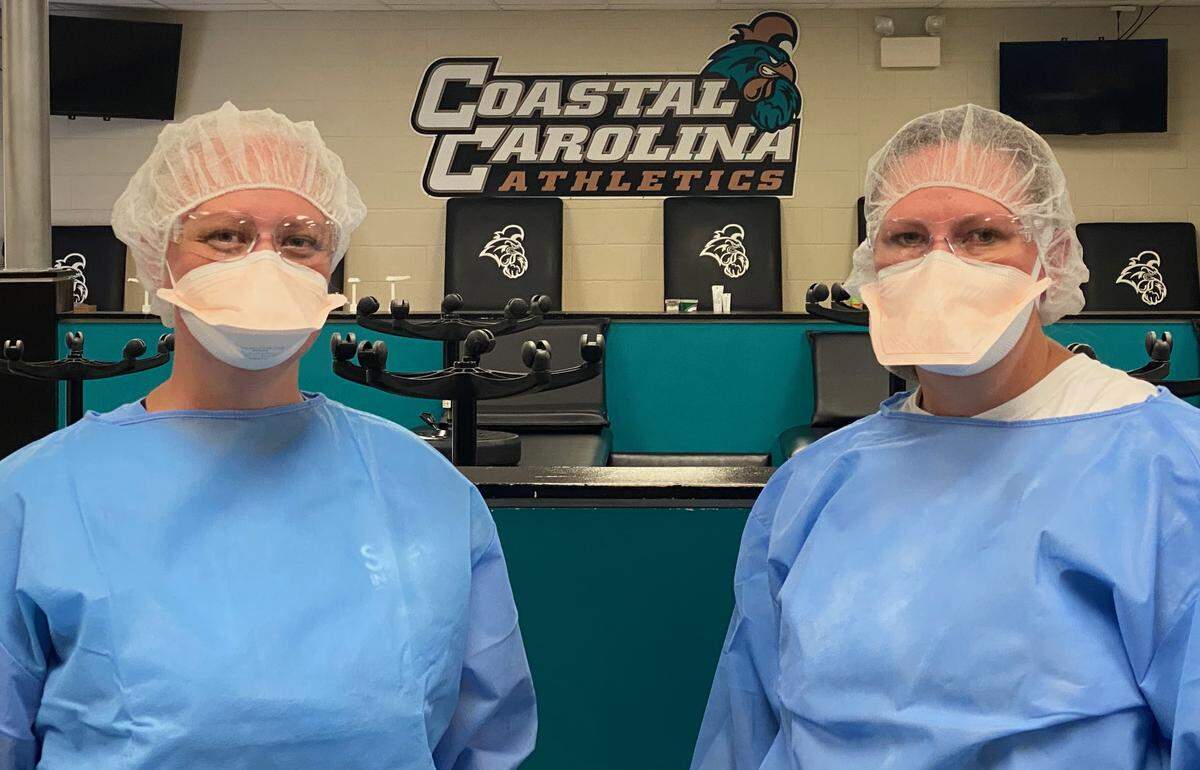
CCU has partnered with Tidelands Health to provide free COVID-19 testing to student-athletes and athletic department staff members as they return to campus.
The comprehensive testing program began June 8 with the beginning of voluntary football workouts. Tidelands Health, the official health system of the Chanticleers, tested about 55 football players and essential staff members.
Testing will continue as the university further implements a reentry plan.
The plan was created in accordance with the South Carolina Department of Health and Environmental Control, the NCAA Resocialization of Sport Plan and the Sun Belt Conference COVID-19 Panel, along with the guidance of CCU’s NCAA Medical Director Dr. Winston D. McIver Jr.
CCU director of athletics Matt Hogue said COVID-19 testing is a necessary step to help keep student-athletes and staff safe as the university slowly resumes athletic operations in preparation for the fall sports season.
“Our team of physicians, athletic trainers and strength and conditioning professionals has worked diligently to comprise a plan in accordance with public health protocols and contingencies with guidance from our state authorities, the NCAA, Sun Belt Conference and our university’s reopening committee,” Hogue said in a news release.
During Phase One of CCU’s reentry plan, screened football players can use on-campus weight rooms and athletic training facilities under the supervision of screened strength and conditioning staff and athletic training staff members.
In addition to the COVID-19 testing program, CCU will have a number of health guidelines and protocols in place, including daily temperature and symptom checks.
Other universities have had multiple players test positive as they return to campus, and many have made them public.
Clemson announced Friday that two football players and a men’s basketball player tested positive out of 169 tests conducted on June 8 on football, men’s basketball and women’s basketball players, as well as athletic staff members.
South Carolina football coach Will Muschamp said USC would not make public the number of football players that test positive, citing privacy concerns from players’ parents and HIPAA law that has to be considered.
Many schools have sided with Clemson’s approach and have been open with the testing results.
Among college athletes and athletic staff that have tested positive for COVID-19, according to reports, are seven athletes in three sports at Arkansas State — one of CCU’s fellow Sun Belt Conference members — as well as three football players at Auburn, five football players at Alabama, two football players and an employee at Marshall, and three athletes at Oklahoma State out of more than 150 athletes, staff and administrators tested.
Positive tests often come from asymptomatic subjects, so the believed presence of the virus would not be known without the mandatory testing by colleges. Health experts believe the highly contagious virus can be passed to others by asymptomatic carriers.
The Division I football oversight committee has drafted and passed a six-week practice plan that includes coaches working with players as early as July 6. The plan must be approved by the NCAA Division I Council at a meeting on Wednesday.
For Coastal and other schools that begin the season on Labor Day Weekend (Sept. 5), required workouts would begin July 13, enhanced training would follow beginning July 24, and a normal preseason camp would begin Aug. 7.
The enhanced training period from July 24-Aug. 6 is new this year and allows athletes to spend up to 20 hours on coach-supervised non-contact activities including weight training, conditioning, film review, walk-through practices and meetings.
CCU 2020 football schedule
Sept. 5 at South Carolina
Sept. 12 at Eastern Michigan
Sept. 19 vs. Duquesne
Sept. 26 vs. Kansas
Oct. 3 vs. Arkansas State
Oct. 17 at Louisiana
Oct. 24 vs. Georgia Southern
Oct. 29 at Georgia State
Nov. 7 vs. South Alabama
Nov. 14 at Troy
Nov. 21 vs. Appalachian State
Nov. 28 at Texas State
This story was originally published June 16, 2020 at 10:52 AM.