
‘Slime’ shows special value for marine life
The heading over the hall door spells it all out: “Slime: The sticky, icky stuff of life.” No need to touch anything; just look in awe.
Entering the newest special exhibit at Ripley’s Aquarium at Broadway at the Beach, everyone can see how slime proves pivotal to the cycle of life for many marine creatures. Narratives at each animal display ooze with information and factoids, all in words, not in goo.
One tank shows symbiosis of two “partners in slime,” each helping the other: clownfish and sea anemones. The latter protects the former from predators, and the clownfish provides a critical housekeeping service and chases away other fish that might nip on the anemone’s tentacles.
A single bullfrog looks quite at ease dangling in a tank, with the top of her head, and eyes and nostrils above the water surface, and arms and legs at rest below. A female of this amphibian typically lays 25,000 eggs in a slime of jelly full of nutrients on which hatching tadpoles can feast in a few days. The other side of this aquarium recently contained about 10 bullfrog tadpoles, each about the size of an adult’s pinkie finger and some with quite the array of teeny spots. Those little frogs-to-be will need three years to reach adulthood, transcending through metamorphosis from a fish with gills into a frog with lungs and legs, all with odds stacked against survival through that stretch, hence the power numbers with all those eggs laid.
A parrot fish makes its own bed by secreting a “slime sleeping bag” from mucous glands near its gills.
The parchment worm, or “slime bag” as noted in a fitting nickname nearby, measures 5.5 to 9 inches. It secretes layers of mucous into a flexible, parchment-like, transparent tube for its protection.
The banana slug glides on a carpet of slime, leaving scented chemicals to attract a mate and for another reason, because as stated: “To a slug, slime is sexy, but to a predator, it’s poison,” numbing the mouth of the attacker.
Check out a sea cucumber, which has openings at each end of its body. Try to ascertain which end is which on this fish.
A predatory snail, which at first looks harmless, comes equipped for survival, mobilizing on a muscular foot, and extending a snakelike proboscis and depositing toxic digestive juices inside its target, into which it tears with toothy radula to vacuum out liquefied flesh. Slow motion is real-life speed for this gastropod.
A hagfish, dubbed “a living fossil” unchanged for 330 million years, will release a chemical protein through about 200 glands, which, mixing with sea water, produces “sticky, stretchy gobs of goo.” This fish, the explanation states, was one of the first creatures to form a brain case or skull, and it has heart — four of them, to be exact.
Discusfish lack mammal glands, but these cichlids’ bodies excrete a breastmilk-like ectoplasm “through hundreds of tiny nipples,” and newly hatched fry will feed on this layer of food from both parents.
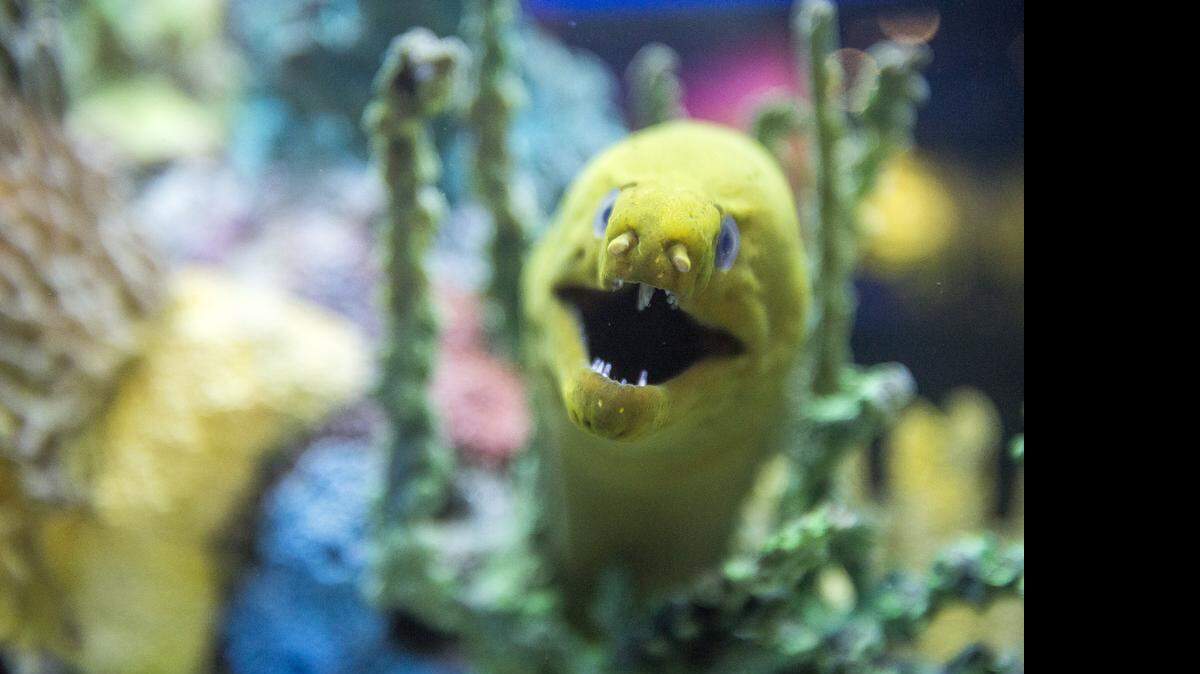
Don’t miss the tank of green moray eels. Never mind that their self-defense, besides their fearsome facial, toothy appearance — with mouths always open, simply to breathe — entails a flesh toxin called ciguatera. These eels, which can grow several feet long, are really blue. They secrete a yellow oily slime that blends with their blue skin, making it look green. So, unlike Kermit the Frog’s signature soliloquy, “It’s not easy being green,” these eels could beg to differ.
A half-hour to an hour will flow by very easily with the slew of information to absorb in this “Slime” exhibit. Also, when a series of low, rumbling sounds radiates repeatedly from the middle of the gallery, that’s just a recording of a male bullfrog advertising his ambition to mate. After all, it is spring.
Contact STEVE PALISIN at 444-1764.
If you go
What | “Slime” special exhibit
When | Tentatively through year’s end
Where | Ripley’s Aquarium, at Broadway at the Beach, on 29th Avenue North, between U.S. 17 Bypass and Robert M. Grissom Parkway in Myrtle Beach
Hours | 9 a.m.-9 p.m. daily
How much | Free with admission, which, plus tax, is $23.99 ages 12 and older (or save $2 advance online from this adult rate), $15.99 ages 6-11, and $6.99 ages 2-5, and free ages 1 and younger.
Local discount | Half off for residents Horry, Georgetown and Brunswick counties with ID.
Annual passes | Plus tax: $54.99 ages 12 and older, $32.99 ages 6-11, and $14.99 ages 2-5, with respective renewal rates of $44.99, $30.99 and $14.99.
Information | 916-0888, 800-734-8888 or www.ripleysaquarium.com
This story was originally published May 27, 2015 at 3:00 PM with the headline "‘Slime’ shows special value for marine life."